Sunday, March 29, 2009

Audrey Hepburn


This week, I am going to talk about one of the most elegant women to grace to screen, Audrey Hepburn. Even though Hepburn was the very epitome of elegance in Hollywood during her reign on screen, her early life was very difficult and not the least bit glamorous. Her parents divorced and her father abandoned the family. After the divorce, Hepburn’s mother moved Audrey and her brother to Arnhem in the Netherlands, thinking they would be safe from Nazi occupation there. However, the Nazi’s invaded the Netherlands in 1940 and life became very hard for Audrey. She was a first hand witness to part of the Holocaust, seeing people rounded up onto trains to go to concentration camps. Hepburn's uncle and her mother's cousin were shot in front of Hepburn for being part of the Resistance. Suffering from malnutrition, Hepburn developed acute anemia, respiratory problems, and oedema.

Although she wanted to be a ballerina, Audrey Hepburn decided to pursue acting. Her first starring role in an American film was opposite Gregory Peck in Roman Holiday, for which Hepburn won an Oscar. She then went on to film Sabrina, with Humphrey Bogart and William Holden, and Funny Face, with dancing legend Fred Astaire, and of course, My Fair Lady, with Rex Harrison.

One thing I have noticed about Hepburn’s films is that she is commonly cast with an older man as her love interest (Humphrey Bogart, Cary Grant, Fred Astaire, Rex Harrison, William Holden, to name a few…). Another thing that I’ve noticed is that her way of speaking and acting is always very refined, and very unique. I haven’t seen anyone speak quite like Audrey in the movies. This raises another question: Would Audrey Hepburn make it in Hollywood today? Would she have the opportunity to become her well known icons of Holly Golightly or Princess Ann, or would she be reduced to character acting in supporting parts (which isn’t a bad thing, but probably a step down from “Audrey Hepburn-ness”). What do you think?

Sunday, March 15, 2009

And the Winner of Best Picture Is...


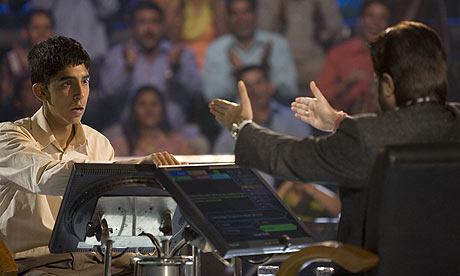
The Academy Awards took place in the end of February. There were some obvious winners that everyone knew would take home the little gold guy, but there were also some surprises...for instance, the winner of the award to end all awards: Best Picture.

I'd never even heard of this movie until I looked at the nominees for the Academy Awards. I was a little mad that this movie from Bollywood, that almost didn't even make it to theatres, had taken away a Best Picture slot from The Dark Knight. In my opinion, The Dark Knight had made the most impact on the culture for the past year, and deserved to at least get nominated. But I decided not to completely write off Slumdog, and went to go see it today.

And I have to say...it impressed me, even though I went in with high standards. The movie is basically what the title says. Jamal, an 18-year-old slumdog from India, enters as a contestant on the Indian version of “Who Wants to Be A Millionaire?”, hoping that his true love, Latika, will see him and come find him. Jamal gets all the answers, despite the fact that he is uneducated. And of course, they think he is cheating. Turns out, he’s not. Jamal knew all the answers because of different life experiences he’s had, and he begins to recall them all as he is tortured and interrogated.

I have not agreed with the past few years of the Oscar winners for Best Picture. For the first time in a while, I am okay with the one they chose. It was refreshing to have a “hero” in a movie that actually had a moral code. Jamal was a good guy. It was nice to have a main character that didn’t look like he’d just stepped out of a Hollister ad, one that stuttered when he talked, one that quietly defended his honor as others mocked him, one that, though he had seen many terrible things, was still apalled every time the human race did something violent. And, he also had a pure, chaste childhood love that he’d do anything to be with and protect. That gets me every time.

[Spoiler Alert]
Slumdog is pretty violent, but not unnessessarily. And unlike most Best Pictures, this one has a happy ending; Jamal and Latika find each other and suddenly break out into an energetic Indian techno dance, with the help of random extras in the background. I definitely didn’t see that one coming.

It's amazing how the movie Slumdog Millionaire parallels its own success in Hollywood.

Sunday, March 8, 2009

I’m Going To Get Kicked Out of Fight Club for This


When asked who should play them in the movie of their life, what is the one name that people say? Although they are usually being sarcastic, the answer I hear the most is “Brad Pitt”.

And why not? He’s a versatile actor, having played a cowboy hitchhiker, a vampire, a con artist, a spy married to an enemy spy, a man aging in reverse, and Tyler Durden from Fight Club, to name a few.

The movie Fight Club didn’t do as well in theatres as expected, but after its release on DVD, it garnered a cult following. The movie centers around a nameless Narrator, who is suffering from insomnia and feels trapped in his white-collar job. He begins attending support groups so he can “appreciate real suffering”, and finally finds himself able to sleep after attending these meetings and crying with the people who are really dying. Then, he meets Tyler Durden (played by Brad Pitt), a soap maker (among other things). They go to the bar, have a few drinks, and just when they’re leaving, Tyler Durden randomly says those fateful words: “I want you to hit me as hard as you can.”

These are the words that started Fight Club, an underground place where men go to beat the crap out of one another. Together, the Narrator and Tyler Durden make up the rules of Fight Club:

1. You don't talk about fight club.
2. You don't talk about fight club.
3. When someone says stop, or goes limp, even if he's just faking it, the fight is over.
4. Only two guys to a fight.
5. One fight at a time.
6. They fight without shirts or shoes.
7. The fights go on as long as they have to.
8. If this is your first night at fight club, you have to fight.

The violence of Fight Club serves as a metaphor for feeling, rather than to promote or glorify physical combat (which I admit, I thought the movie was about before watching it: A bunch of guys out to prove their masculinity by beating each other up). The fights represent the impulses these men have to break out of society.

Although the actual fight scenes serve to show how these men desire to feel, the subject of how these men are struggling to be men is touched on, too. Several times in the movie, the Narrator and Tyler talk about how messed up the version of how men are "supposed to be like" really is and how they’re personally struggling to be men because their generation was raised by women and they didn’t have a man to look up to.

I feel like there were a lot of subliminal messages in Fight Club (subliminal messages was another theme the movie touched on), and I’m pretty sure I missed most of them. After all, I’ve only seen Fight Club once. Warning for all those who have yet to see it and want to: It is graphic and kind of weird. And it feels kind of like watching a dream, especially when you see a penguin playing in the Narrator’s relaxation cave (Don’t ask).

So if you’re feeling a little fed up with what society tells you to be like: take Tyler Durden’s example. Sell all your worldly possessions, move into a dilapidated house, and start a Fight Club.

Thursday, February 26, 2009

A Box of Chocolates


“Momma always said life is like a box of chocolates. You never know what you’re gonna get.”

(If you haven't seen Forrest Gump, here is a quick recap)

Tom Hanks immortalized the man known as Forrest Gump, showing us the events of the world from the innocent perspective of a man with an IQ of 75.

Although this movie showcases events in history such as the Watergate Hotel scandal, President Kennedy’s assassination, and Hurricane Carmen, this story centers around Forrest and his pure, chaste love for his childhood sweetheart, Jenny, which is what we're going to be exploring this week.

Forrest fell in love with Jenny the moment she let him sit by her on the bus on his first day of school. Forrest testifies years later that he had “never seen anything more beautiful in his entire life”. She is the first person that showed him kindness (besides his momma), and he develops a deep attachment to her, the girl with the “most beautiful voice in the wide world”.

I’ve watched this movie many times over, and each time, I realize something more about the character of Forrest Gump that I didn’t realize before. The first time I saw a clip of it was when I was five (just the “Life is like a box of chocolates” scene), and I didn’t even realize that Forrest was mentally handicapped. In fact, I only remember thinking that the lady sitting by him on the bench was being rude to him, only answering him with minimal language. As I got older, I began to realize more of the emotions that other characters were feeling, such as Lieutenant Dan when he legs lost his legs. I started recognizing more of the songs of the period (Simon and Garfunkel, the Doors). I also realized that although Forrest was capable of loving Jenny completely and irrevocably, she didn’t love herself.

This is evidenced by the scene in which Jenny is getting grabbed by some men at the strip club, and Forrest beats them up. Jenny flies into a rage, telling Forrest to “stop it” and that he “can’t keep trying to save her”.

“I can’t help it.” Forrest drawls, “I love you.”

“Forrest…you don’t know what love is.” Jenny replies snidely.

This is a statement that sticks with Forrest throughout the whole movie, moreso than being called “idiot” or “stupid” (“Stupid is as stupid does.” Sorry, I had to). In a poignant scene near the end of the movie, which takes place decades after Jenny told Forrest he didn’t know what love was, Forrest gets quiet and says, “I'm not a smart man. But I know what love is.”

And indeed he does. Throughout the film he constantly displays unselfish love for the people in his life. He doesn’t think twice when he runs back into a Vietnam forest that is being bombed, because he knows his “bestest good friend”, Bubba, is in there. He jumps off his shrimping boat and swims to shore when he hears that his Momma is sick. When he bumps into Lieutenant Dan, a now-wheelchair bound veteran, Forrest spends New Years with him. Even after Jenny refuses his marriage proposal and takes off, Forrest runs to her side when she calls for him. I can’t think of a scene where Forrest isn’t caring for someone or loving someone around him, even though, technically, it should be vice versa, since he is mentally handicapped.

And that’s all I have to say about that. :)


(Okay, I know you have memories or a favorite scene from Forrest Gump, so leave a comment telling us about it.)

Sunday, February 22, 2009

The Voice Behind the Faces


Have you ever seen My Fair Lady, West Side Story, or The King and I? They are all beautiful musicals that garnered praise and Academy Awards. Maybe you’re wondering what these movies have in common, besides their type of genre, and the answer is simple: Marni Nixon. No, she was not a director, a producer, or even an extra hanging out on the back of a scene. But even though you didn’t see her on the screen, I’m betting that you heard her.

Marni Nixon was the singing voice for the leading ladies of these movies and more. She was the voice of Maria from West Side Story, Anna from the King and I, and Eliza Doolittle from My Fair Lady. And she was not credited. This was back in the 1960’s when the singers who dubbed the songs for actors and actresses were not given nationwide credit for lending their voices to the big screen. Audiences generally believed that actresses such as Audrey Hepburn, Deborah Kerr, and Natalie Wood had phenomenal singing chops as well as acting talents.

All of these movies have been near and dear to my heart since childhood. It was quite a shock to discover that my dear Audrey Hepburn didn’t actually sing about how “loverly” she felt. Or that maybe while Deborah Kerr could whistle a happy tune, she couldn’t carry one. Even Natalie Wood, miscast as a Puerto Rican, due only to the fact that she was a major star, had me believing that maybe they cast her because of her singing skills. No such luck. Only her thick, fake, Puerto Rican accented lines were her own.

These leading ladies received Academy Award attention for their roles in these musicals. But I think they are fooling themselves if they believe it was merely on their acting abilities. While they are good at acting, the crew of their films misled the audience to believe that they performed their roles in their entirety. Despite the fact that it is decades after the fact, should Marni Nixon receive some type of award for her contributions to these films? What do you think?

(One last little tidbit: Marni Nixon’s last recorded song for a movie was the 1998 Disney film, Mulan, where she was the voice and singing voice of Mulan's feisty Grandma Fa. And Marni was credited for both talking and singing.)

Saturday, February 14, 2009

Somewhere Over the Rainbow


Frances Ethel Gumm was born June 10, 1922, in Grand Rapids, Minnesota. She began her acting and singing career when she was only three years old, and continued for four and a half decades. She received a special Juvenile Academy Award, won a Golden Globe, as well as some Grammy Awards and a Tony Award. Her rendition of the song “Somewhere Over the Rainbow” was chosen as the #1 song of the century by the American Film Institute. She changed her name somewhere along the way, to the name most of the American public recognizes – Judy Garland. But even though the still-popular children’s movie, The Wizard of Oz, may have shown us the sweet, innocent side of Judy, there was more to her than meets the eye.

Despite her triumphs in Hollywood, Garland had many personal problems during her lifetime. She was insecure about her appearance, due to the fact that many film executives told her she was unattractive and overweight. MGM, the studio she was signed to, gave her drugs to keep her energy level high and her weight level down. Garland became addicted to these drugs for decades. Although she was famous, Garland was not financially stable. She owed hundreds of thousands of dollars in back taxes (IMDB).

Not only was Garland having trouble financially, she was struggling in her relationships, as well. She divorced four out of the five times she was married. She also tried to commit suicide several times, until she finally died of an accidental drug overdose when she was forty-seven, leaving behind her a legacy from Hollywood’s Golden Age and three children.

In 1997, Garland was awarded a Grammy Lifetime Achievement Award, but she never lived to accept it. The American Film Institute named her the #8 greatest female star in Hollywood history. Although Garland is gone, she will live on, through her movies, her recordings, and in that song everybody knows the words to. Maybe the fact that her life was so hard made the wishful emotion in her voice during “Somewhere Over the Rainbow” more real for audiences listening to her.

I watched the Wizard of Oz many times as a child. I never would have guessed that the wide-eyed teenage star of this iconic film would have gone through so many troubles during her lifetime. I always thought of Dorothy as happy and innocent. But I guess that’s part of the magic of Hollywood: You see only what they want you to see.

Saturday, February 7, 2009

Read This Blog, You Will


When someone wants to mimic being a “master” at something, or is giving wise counsel to a friend, they often adopt the habit of talking like they don’t know whether a verb or a noun goes first in a sentence (ex. “Speak like an idiot, I will.”) You have, no doubt, imitated this great Jedi’s voice once in your lifetime. This week, I’m going to discuss the pinnacle of the Jedi Temple, the greatest master of them all. Even for those who haven’t seen Star Wars, they probably recognize the awesome little green guy from the movie.

Master Yoda, he is.

Yoda is one of the great movie-mentors, up there with Mr. Miyagi and Morpheus. He is wise in his old age (which, by the way, is approximately 900 years old during the Star Wars movies)and has great nuggets of wisdom that he can’t wait to dish out (“Do or do not, there is no try”).

Luke Skywalker, the main hero of the earlier Star Wars trilogy, started his Jedi training with Obi-Wan Kenobi when he was a mere farm boy from Tatooine. But after Obi-Wan died (sorry if I spoiled that, but you really should’ve seen Star Wars by now), Luke was left alone, his training incomplete. Obi-Wan’s spirit sent him to the Dagobah System, an entire planet that is one big swamp. There, Luke meets Yoda, but doesn’t realize that it is the diminutive green creature is the Jedi Master he is looking for. Yoda finally reveals himself and Luke begins the completion of his Jedi training, so he can face Darth Vader once and for all.

In Episodes 1-3, Yoda is the head of the Jedi Council. Every single Jedi Master looks up to him, and they have reason to. Yoda never makes mistakes and is a cornucopia of fortune cookie sayings. The only mistake he made was allowing young Anakin Skywalker to begin training as a Jedi at the ripe old age of 9 (training usually begins when the child is a toddler), even though he had reservations, due to the boy's anger issues. This ultimately cost the Jedi their entire way of life, their lineage burned to the ground, thanks to Skywalker, Sr.

In Episodes 5-6, Yoda is reduced to living in hiding on the planet Dagobah. If you watch the movies in the order they were made, we first see Yoda through Luke's eyes and write him off as a crazy little green elf who steals Luke's flashlight and dinner. Yoda's disposition changes entirely once he tests Luke's patience, however, and suddenly, he's not just a crazy little green elf, but a Jedi Knight who is far more intelligent than he lets on.

I always thought that Yoda was the one of the best characters on Star Wars (Han Solo is right up there, too. Come on, it's Harrison Ford), for these reasons:

1) He's green.
2) He can lift small aircrafts out of mucky swamps with nary an effort
3)He can take on a Sith Lord even though he is 1/4 his enemy's size.

But the main reason I have a soft spot in my heart for Yoda is for this reason: He has shown us that "size matters not". You don't have to be ripped like Rambo or Arnold Schwarzenegger to kick some bad guy butt. All you need is a little faith; in yourself, in others, and in the Force.